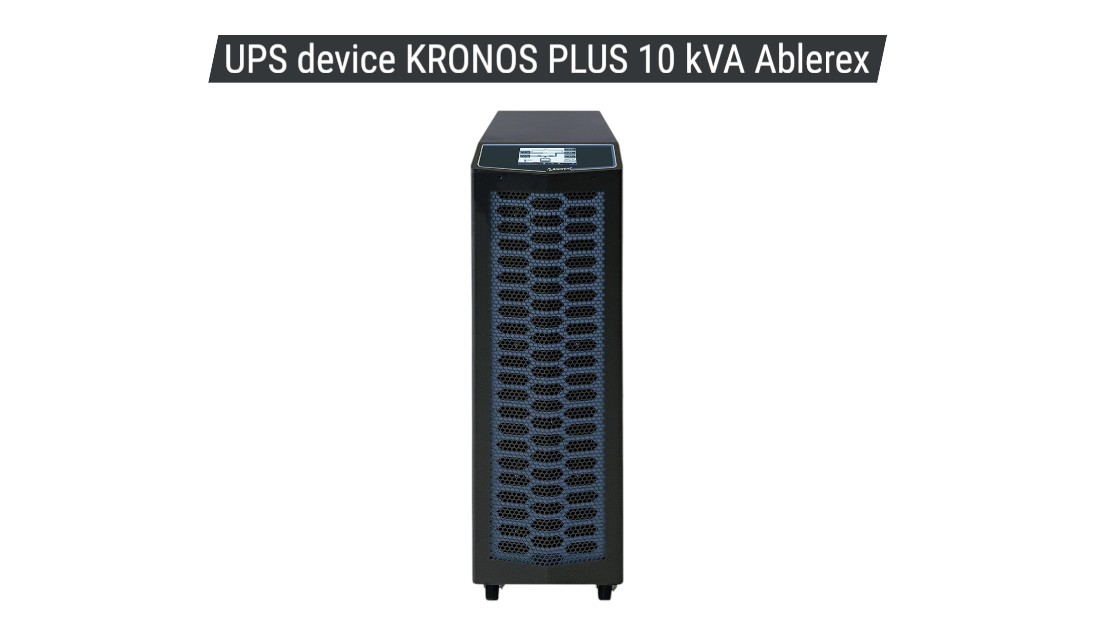
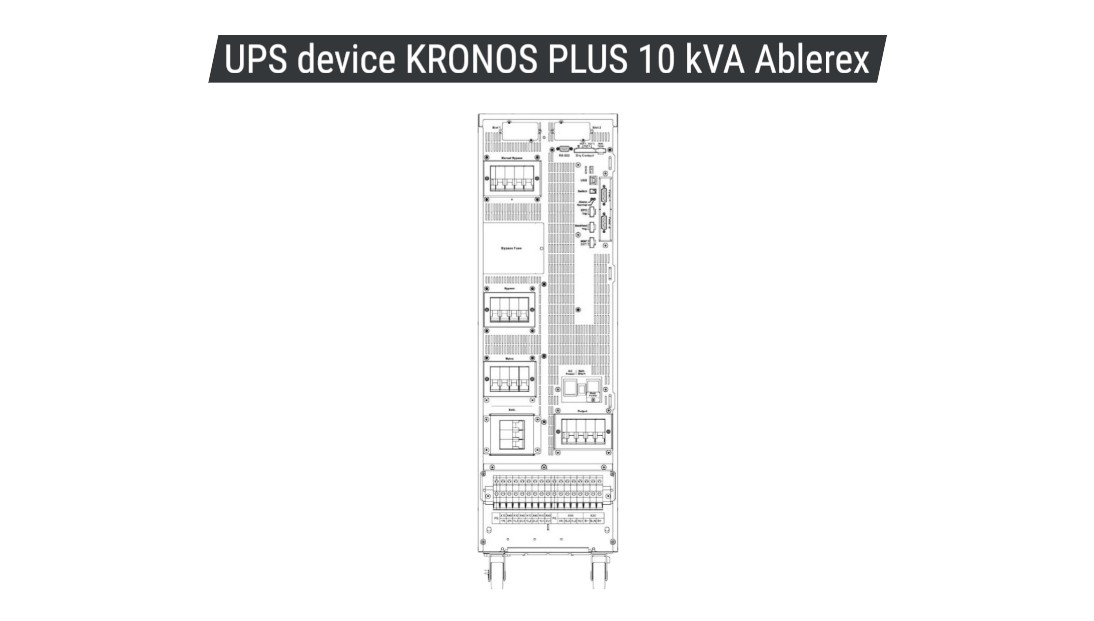
UPS device KRONOS PLUS 10 kVA Ablerex

TECNOLOGY: ONLINE, DOUBLE CONVERSION

POWER FACTOR: 1.0

POWER: 10000VA/10000W

USAGE

SHOP
HOTEL

SMALL
OFFICE

HOSPITALS
MEDICAL CENTERS

INDUSTRIAL
PLANTS

SERVER
RACKS

CCTV
SURVEILLANCE

TECHNICAL DATASHEET

KRONOS PLUS 10 kVA Ablerex UPS Device

The KRONOS PLUS 10 kVA UPS device from Ablerex is a new-generation three-phase online UPS, designed to offer the highest efficiency and power in an exceptionally compact chassis. With its power factor PF=1 (kVA = kW), it ensures maximum energy utilization, making it ideal for protecting modern critical applications in limited spaces such as server rooms, data centers, and industrial facilities. The unit stands out for its exceptional flexibility, allowing easy on-site configuration for operation with three-phase or single-phase output (for the 10, 15, and 20 kVA versions), is prepared for lithium batteries, and features patented technology for working with regenerative loads.

Compactness and High Performance

The KRONOS PLUS 10 kVA is designed for environments where every square centimeter counts. It features the smallest footprint in its class (just 0.22 m² for the 20 kVA model with internal batteries). Thanks to the vertical internal layout of components and practical wheels, the unit is easy to position and maintain. Despite its compact dimensions (W 26 x D 85 x H 89 cm), it offers built-in batteries of up to 40 x 9 Ah (for the 10, 15, and 20 kVA versions), allowing for significant autonomy without the need for an external battery cabinet.

High Efficiency and Cost-Effectiveness

The unit achieves impressive efficiency: up to 95% in online mode and up to 98% in ECO mode, guaranteeing low operating costs. Thanks to the power factor PF=1, it utilizes its full capacity, reduces heat dissipation, and is fully compatible with sensitive equipment. The low input current total harmonic distortion (THDi < 3%) ensures high-quality power supply, improves the longevity of connected devices, and minimizes the impact on the mains supply.

Innovative Technology for Regenerative Loads

The KRONOS PLUS 10 kVA possesses the unique patented GLM® function, which makes it ideal for applications with generative (regenerative) loads such as lifts, cranes, CNC machines, flexographic printers, radar, etc. This function intelligently manages the energy generated back from the load, defining the most efficient operating mode for the system and ensuring reliable protection even under these specific conditions.

Flexibility, Scalability, and Easy Management

  • Parallel Operation: To achieve higher power or redundancy (N+1), up to 6 units can be connected in parallel, with configuration easily set via the touch display.

  • Battery Configuration: The unit offers exceptional flexibility with a variable number of battery blocks (from 26 to 40 x 12V), configurable directly from the display. The possibility of common or separate battery banks for parallel systems is also supported to optimize costs and runtime.

  • Smart Testing: The smart ageing self-test function allows component verification without a real load, saving over 90% energy during tests and facilitating commissioning and maintenance.

  • Easy Installation and Maintenance: The internal manual bypass and 4-pole switches ensure the safest maintenance without disconnecting the load. The unit detects and indicates an incorrect phase sequence at the input without interrupting the power supply and battery charging.

Control and Communication Capabilities

The device offers exceptionally rich communication capabilities:

  • Intuitive Interface: A 4.3-inch color LCD touchscreen display with 14 languages facilitates navigation, configuration, and management.

  • Built-in Ports: It comes standard with RS232, USB, programmable relay contacts, as well as two additional slots for optional communication cards. All event logs (up to 800 events) and settings can be saved to an SD card.

  • Optional Communication Cards: For full integration, the following are available:

    • SNMP card for monitoring and management via the LAN network, including remotely via VPN, and sending alarms by email.

    • RS485 Modbus card for communication with Building Management Systems (BMS), PLC, and SCADA.

    • Programmable relay card (6 inputs / 6 outputs) with dry contacts.

    • Environmental monitoring sensor (temperature and humidity).

Accessories for Expanding Functionality

  • External bypass (Bypass 10-20): For safe maintenance.

  • Isolation transformers (TRAFO 10-20): For galvanic isolation and noise suppression.

  • Parallel kit (PARKIT KR) and cables (PARCAB30-80): For implementing parallel operation.

  • Remote panel (REM.PANEL): A movable 7″ touch panel for monitoring up to 64 units.

  • Battery temperature sensor (TEMP.SENS TS/KR): For optimal charge management.

Applications of the KRONOS PLUS 10 kVA Ablerex UPS Device:

  • Server rooms, micro and mini data centers

  • Telecommunications and broadcasting equipment

  • Electromedical equipment

  • Industrial applications and regenerative loads (lifts, cranes, CNC machines, radar, etc.)

Advantages of the KRONOS PLUS 10 kVA Ablerex UPS Device:

  • Smallest footprint in its class: Ideal for limited spaces with built-in batteries up to 40 x 9 Ah.

  • High efficiency (up to 95% online / 98% Eco): Low operating costs and minimal energy losses.

  • PF = 1 (kVA = kW): Full power utilization for modern loads.

  • GLM® patented technology: Specialized protection for regenerative loads (lifts, machines, etc.).

  • Exceptional flexibility: Configurable 3/1-phase output (for 10-20 kVA) and variable battery count.

  • Scalability: Capability for parallel operation of up to 6 units.

  • Rich communication interface: USB, RS232, relay contacts, 2 slots for optional cards (SNMP, Modbus, relay), and SD card.

  • Lithium battery support (Li-ion): Readiness for the most modern energy solutions.

  • Safe maintenance: Built-in manual bypass, 4-pole switches, and incorrect phase sequence indication.

  • OPPORTUNITY TO RENT A UPS DEVICE
  • OPPORTUNITY FOR OPERATING LEASING OF UPS DEVICE

Maintenance of UPS devices

I Maintenance during the warranty period

Warranty maintenance of your backup equipment – this is our professional and moral obligation, and we fulfill it unconditionally and flawlessly. Therefore, each project does not end with the installation and commissioning of generators and UPS systems. By following this philosophy, we receive the highest ratings from our clients for proven professionalism.

II Maintenance after the warranty period expires

The reasonable use of machines extends beyond the warranty period, and we know that the better they are maintained, the longer they will serve you. Post-warranty maintenance is a reasonable and forward-looking choice as an investment in the future of your equipment. We offer a wide range of services in the form of subscription-based maintenance or one-time services, through which we ensure device monitoring and timely troubleshooting. Contact us for more details and an individual offer for subscription maintenance of your generators and UPS devices.

III UPS preventive maintenance

The inspection of a UPS device includes a specific and comprehensive list of activities for monitoring important functionalities and components. In addition to the machine components, specific battery tests are carried out, as well as individual measurement of charge, resistance, and connections. And not only that – we clean the system from dust and other contamination.

Why is UPS device maintenance important?

Timely maintenance is the most effective prevention that will protect you from the situation of discovering that your device is not functional exactly when it needs to perform its main function – protection against power surges and ensuring uninterrupted power supply. Prevention reduces the need for treatment – this principle in healthcare is also valid for critical and backup power systems.

Batteries for UPS devices

I Importance

Batteries are the most critical component of a UPS device. They also represent a substantial part of its value. Batteries have a defined useful service life, after which they must be replaced. This period depends significantly on the environment in which the device operates, the instances of battery discharge, and especially the cases of deep discharge.

II Quality of batteries for UPS devices

It is extremely important to use high-quality batteries. High-quality batteries guarantee the trouble-free operation of the device. This is because even a single defective battery can completely compromise the operation of the device. High-quality batteries also withstand the “stress” of discharges better. And last but not least – high-quality batteries have multiple protections against ignition and burning – a problem that is not as widespread with traction VRLA batteries as it is with lithium-ion batteries, but which nevertheless cannot be excluded under poor operating conditions and various types of failures. In view of their service life and reliability, high-quality batteries are significantly more cost-effective.

III Representation

We are the exclusive representative of the leading high-quality battery brands FIAMM and HOPPECKE.

IV Services and expertise

Based on the specified backup requirements, we configure each UPS device with the necessary number and capacity of internal and/or external battery packs. Upon expiration of the service life (or under other circumstances), we carry out replacement with new ones. All activities are performed professionally, with responsibility towards the devices, personnel, the client’s equipment, as well as the specifics of the site. We are available for detailed consultation regarding your backup capacities, systems, their status, and capacity.

Upsaas

How can you acquire a UPS device?

The answer seems obvious – by purchasing it, right? But as obvious, natural, and of course applicable as this answer may be, it is incomplete and hides certain inaccuracies. Why…? Because we can offer you something different as well, as an alternative solution that adds value for you.

Here it is important to define some essential differences regarding single-phase and three-phase UPS devices, related to their application, installation, maintenance, scale, etc.

With single-phase UPS devices, no significant technical expertise is required for connection and activation. With three-phase industrial solutions, it is exactly the opposite, and for this reason below we briefly describe the entire process* related to industrial equipment for critical power supply.

Although three-phase UPS devices and systems are significantly more expensive per unit, single-phase UPS units are far more numerous in terms of quantity and distribution. They are present in every company office, bank, insurance company, at every gas station, at the checkout of every store, in every fire alarm system, security system, in homes, educational institutions, healthcare and other public facilities.

Depending on the type of company and application, the investment in several dozen or even hundreds of single-phase UPS devices installed at different points, branches, and facilities of a company can be truly significant despite the relatively low unit price. The geographical distribution itself is also a significant cost, not only from the point of view of initial delivery, but also in relation to subsequent maintenance.

Due to the large number and geographical dispersion (the case referred to in items 2 and 3 above), regular maintenance and servicing of the machines may become unmanageable for the user. This can shorten the operational life of the machines, which leads to low utilization and accordingly puts the initial investment at enormous risk.

In view of these and other specifics, in addition to the classic method of acquisition through purchase, we also offer an alternative solution through which we solve the problems in item 4.

Ups as a service or ups as a service (upsaas)

A fixed monthly all-in fee that includes: delivery, installation, regular maintenance, response, device replacement (when necessary), battery replacement, relocation, etc.

In this way the user:

  • always has up-to-date devices in excellent condition, with a fixed and therefore predictable cost for the service;

  • is not engaged in maintenance and any worries regarding the condition of the machines;

  • does not deal with the purchase of new devices, their delivery and installation, as well as the not insignificant relocation, decommissioning, and recycling of old, out-of-use equipment.

We do all of this for all your devices for a fixed fee.

“… as a service” has become an extremely popular form of acquiring and/or using tangible assets, equipment, software products, printing. In reality, this form exists all around us, wrapped in different concepts reflecting specific nuances – rental, leasing, temporary use, payment based on various indicators – period, printed copies, number of users, number of applications from the total package, mileage, and many others.

Our UPSaaS service is conceptually no different and is fully applicable. Often the UPS device is the last thing someone pays attention to, and employees often do not even know about their existence. At the same time, this important, invisible “guard” that provides protection and backup requires, albeit minimal, but regular care. We take responsibility for this care.

And not least of all… these machines and their batteries are quite heavy! You need to change a location or locations in your network of offices, stores, etc. Don’t think about it. It is our responsibility to move the UPS devices, i.e. to move the service.

Range of single-phase ups devices

Our range of single-phase UPS devices that we can provide as a service covers all traditional power ratings and applications. Some models such as Glamor S and Ares PRO, with their specific technical characteristics, even exceed the standards for this segment.

Conclusion

You are already convinced that UPSaaS (as a service) is the solution you have been looking for! Let’s talk. We are available to go into detail regarding your needs, locations, applications, requirements. We document everything discussed, provide a solution, financial framework, delivery timelines, service schedules… and after some time the invisible guards become even more invisible to you, but guaranteed always in perfect condition!

Your costs and commitments will decrease, while your security and peace of mind will increase!

UPSaaS is a key solution for any business with single-phase UPS devices.


Industrial three-phase ups systems

Steps in the process of developing this type of projects

For us, providing UPS systems for industry, healthcare, data centers, infrastructure facilities, public administrative and commercial centers, logistics bases, etc. is a moral duty and a professional responsibility. The guarantee for this is a process that we follow without deviation.

I Objective consultation

Assessment of your capacities, loads, needs, requirements, development plans, etc. And why is this step important? Because objectivity in providing a solution is of fundamental importance for the proper functioning of the capacities.

Visits to your site (if already built) and measurement of actual loads.

If you are at the project stage, analysis of the project and guidance.

Provision of a technical solution – specification of model, technology, design of the UPS device. The technical solution includes a justified proposal for a suitable device from the point of view of power, technological structure, application, operating conditions, etc.

Batteries providing the required backup. The proper functioning of the system depends on the battery set. Accurate calculation and transparency for the proposed model, capacity, number of batteries. We work only with high-end batteries HOPPECKE, FIAMM with an operational life of 10–12 years.

Detailed description of the delivery and installation process.

II Financial proposal

The financial proposal is entirely based on the technical solution prepared during the consultation process. It includes all components – UPS devices, batteries, battery racks or cabinets, necessary materials, additional bypass and disconnect panels (when required), etc. Delivery and installation costs are also specified.

III Implementation

After signing the contract, implementation begins. At this stage, deliveries from manufacturers and other suppliers are coordinated, deliveries to the site, unloading, lifting equipment, and other logistics.

Days and time windows for installation, wiring, and system activation are planned, as this may be associated with power interruptions at the site.

IV Activation, staff training, signing of handover protocols

This is the phase in which the system enters operation. It is an important stage in which the site is effectively considered backed up with critical power supply and protected against power surges and short-term grid outages.

V Maintenance

It may be based on a separate subscription maintenance contract or on an “on-call” basis. A subscription maintenance contract provides a number of advantages and is therefore preferred by customers. It is also more cost-effective.

Regardless of the chosen option, servicing and preventive maintenance are carried out according to a strict list of activities and procedures. And last but not least – we measure the charge and internal resistance of each battery individually. This is perhaps the most important prevention for the battery set and battery life.

  • UPS device KRONOS PLUS 10 kVA Ablerex –  TECHNICAL DATASHEET PDF файл
  • UPS device KRONOS PLUS 10 kVA Ablerex –  BROCHURE PDF файл
  • UPS device KRONOS PLUS 10 kVA Ablerex –  CATALOGUE PDF файл

USEFUL INFORMATION

Types of UPS devices

There are two main classes of UPS devices according to the technology used: The basic one uses the “Line Interactive” technology. Such devices are also called “protectors” and are primarily used to protect consumer equipment. The high-end, professional class uses “Online” technology, with the best having a pure double-conversion sine wave.

UPS functions

The function of the UPS device (uninterruptible power supply) is to ensure an uninterrupted supply of power to the consumer equipment. UPS devices are not an emergency power source (the power generators are). They serve to provide temporary power (usually from 1 to 5 minutes) – until the replacement of the main power source with an emergency one is established.

In some cases, when there is no emergency power source (power genset), the UPS unit could perform this function. Still there are two options to ensure longer period of autonomy; either more powerful UPS than need from consumer to be used or additional battery boxes to be installed.

UPS batteries

Batteries are the “heart” of the UPS device and form a significant part of its value. They should be properly selected and maintained. Batteries have a certain period of life, after which they should be replaced.

UPS battery support

Proper battery maintenance ensures seamless use of the UPS device at its full capacity. Batteries life stages: they reach their maximum capacity after 3 discharge/charge cycles, after which they begin to slowly lose their qualities (thus reserved time goes slowly down). The main indicator of the “health” of batteries is their internal resistance. Regular monitoring of the resistance (by measuring each battery) gives a clear picture of the state of the batteries and allows promptly on-time replacement in the event of a problem.

UPS battery discharge

Deep discharge is a state of using more than 70%-80% of the battery capacity. Any achievement of a deep discharge condition substantially reduces the useful lifespan of the batteries. Most hi-end devices have built-in deep charge protection functionalities and cut off the supply of power to the consumer when the output voltage from the batteries drops down to levels of 10.8-10.5 Vac. The guaranteed autonomy time at the corresponding load, provided as an indicator by the manufacturer in the technical spreadsheet, indicates the period of discharge of the batteries from 100% until the moment of protective shutdown due to potential deep discharge.

When discharged, batteries release heat. Therefore, it is very important that the industrial UPS devices work in air-conditioned rooms, with the air conditioners also being reserved. The optimal temperature environment (16-20°C) ensures trouble-free operation of the device and longer battery life. On the contrary: if the batteries are in an aggressive environment (above 30°C), their life is significantly shortened and there is a risk of fire.